
Beam Bridges
Beam bridges are the simplest and most common type of bridge. They consist of horizontal beams supported at each end by piers or abutments.

Key features of beam bridges:
- Span short to medium distances efficiently.
- Easy to construct with reinforced concrete or steel.
- Cost-effective for small river crossings.
In Oman, beam bridges are often used for rural roads and minor river crossings due to their simplicity and low maintenance requirements.
Advantages: Low cost, straightforward construction, and adaptability to various sites.
Disadvantages: Limited span length and less visually appealing for large rivers.
Arch Bridges
Arch bridges use a curved structure to transfer loads from the deck to abutments at each end. The arch distributes weight efficiently, allowing longer spans without intermediate supports.
Key features of arch bridges:
- Structurally efficient for medium spans.
- Can be constructed using concrete, stone, or steel.
- Provide aesthetic appeal, often used in urban and tourist areas.
In Oman, arch bridges are selected for scenic or historical locations where architectural elegance is desired.
Advantages: Strong and durable, visually attractive.
Disadvantages: Require strong abutments and careful engineering, slightly higher construction cost.
Suspension Bridges
Suspension bridges feature cables suspended between towers, holding the bridge deck below. They are suitable for long spans where intermediate piers are not feasible.
Key features of suspension bridges:
- Support very long spans, ideal for wide river crossings.
- Flexible design that can withstand wind and seismic forces.
- Iconic structures often serving as landmarks.
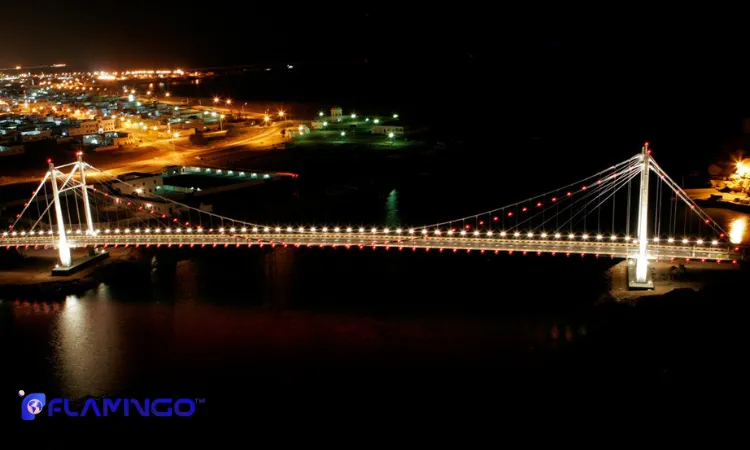
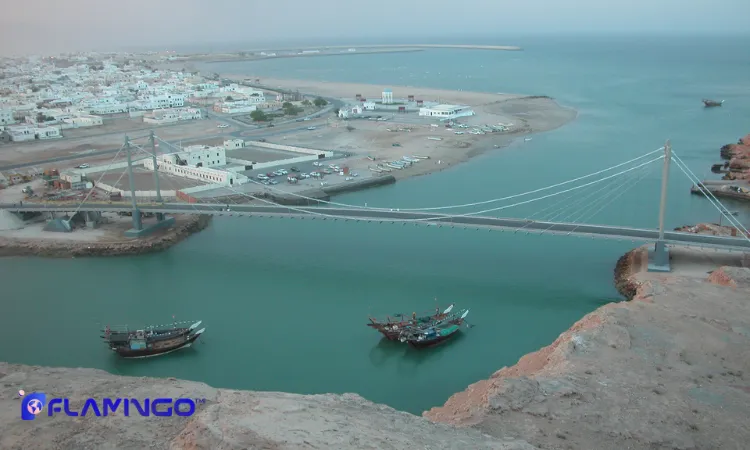
Suspension bridges in Oman are used sparingly, typically in strategic locations requiring long clear spans and high traffic capacity.
Advantages: Long spans, aesthetic appeal, flexibility.
Disadvantages: High construction and maintenance costs, complex engineering.
Cable-Stayed Bridges
Cable-stayed bridges have one or more towers with cables directly supporting the bridge deck. They differ from suspension bridges by transferring load directly to towers rather than via a main cable.
Key features of cable-stayed bridges:
- Suitable for medium to long spans.
- Fewer materials required than suspension bridges.
- Faster construction compared to suspension bridges.
In Oman, cable-stayed bridges are emerging in commercial and highway projects, offering modern design and efficient load transfer.
Advantages: Efficient for medium-long spans, visually modern, faster construction.
Disadvantages: Require precise engineering and careful construction sequencing.
Truss Bridges
Truss bridges use a network of triangular elements to distribute loads. They are often made from steel or timber and are suitable for medium spans.
Key features of truss bridges:
- Ideal for heavy loads and industrial use.
- Efficient material usage with high structural stability.
- Can be prefabricated and assembled on-site.
Truss bridges in Oman are primarily applied in industrial or logistical areas where strength and durability are critical.
Advantages: Strong and material-efficient, easy to maintain.
Disadvantages: Less visually appealing, limited to medium spans.
Read More : Warehouse Construction in Oman
Factors Influencing Bridge Design over Rivers in Oman
Bridge design over rivers in Oman is influenced by several key factors:
- River width and flow: Wider rivers require longer spans or specialized designs.
- Geotechnical conditions: Soil type, flood risk, and erosion impact foundation and pier design.
- Traffic load: Design must accommodate expected vehicles, pedestrians, and future traffic growth.
- Climate conditions: High temperatures and occasional flash floods necessitate durable materials.
- Regulations: Compliance with Oman Ministry of Transport standards and international bridge codes ensures safety and longevity.
Careful analysis of these factors ensures bridges are safe, durable, and cost-effective.
Construction Materials and Techniques for River Bridges
Common materials and techniques used in Omani river bridges include:
- Reinforced concrete: Preferred for durability and ease of maintenance.
- Structural steel: Offers high strength-to-weight ratio for long spans.
- Composite materials: Increasingly used for corrosion resistance.
- Prefabrication: Sections are built off-site and assembled on-site, speeding construction.
- Piling and deep foundations: Required for bridges over soft soils or flood-prone areas.
Advanced construction techniques such as incremental launching, cantilever construction, and cable-stayed assembly are applied depending on the bridge type and site conditions.
Notable River Bridges Projects in Oman
Oman has several important river bridges that demonstrate modern engineering capabilities:
- Al Batinah Coastal Highway Bridges: Multiple beam and arch bridges improving connectivity along the coast.
- Wadi Al Abri Bridges: Combination of beam and truss bridges for rural road connectivity.
- Muscat Expressway Bridges: Modern cable-stayed bridges facilitating high traffic volumes.
These projects improve regional accessibility, stimulate local economies, and reflect the country’s commitment to infrastructure development.
Challenges in Constructing Bridges over Rivers in Oman
Constructing river bridges in Oman involves several challenges:
- Extreme weather: Flash floods can affect construction schedules.
- Remote locations: Transporting materials and equipment to remote sites is challenging.
- Budget constraints: High-quality materials and complex designs increase costs.
- Technical complexity: Long-span and suspension bridges require advanced engineering expertise.
Effective planning, risk management, and modern construction technologies help mitigate these challenges.
Read More : Building Construction Process & Timeline in Oman
Future of River Bridge Construction in Oman
The future of river bridge construction in Oman includes:
- Increased use of modern materials such as fiber-reinforced composites.
- Adoption of Building Information Modeling (BIM) for efficient design and maintenance planning.
- Expansion of highway and urban bridge networks to support growing traffic demands.
- Integration of sustainable designs to reduce environmental impact and energy consumption.
Oman’s infrastructure development plans continue to prioritize safe, durable, and efficient river bridges that meet both functional and aesthetic standards.
Conclusion
Understanding the types of bridges over rivers in Oman is essential for engineers, developers, and policymakers. Each type—beam, arch, suspension, cable-stayed, and truss—offers unique benefits and considerations depending on span, load, environment, and budget.
By carefully evaluating design factors, materials, and construction techniques, Oman can continue to expand its bridge network safely and sustainably. Notable projects highlight the nation’s progress, while future plans ensure that bridges remain key assets in supporting economic growth, connectivity, and urban development.